
Indian Kundan jewelry comes with its own vocabulary, and most shoppers meet it for the first time on a product page full of words like jadau, satlada and chandbali. Each label points to a real difference in shape or length, and two necklaces with the same stones can sit on the body in very different ways.
Learning the names makes shopping much faster. A collection of Indian Kundan jewelry can run into hundreds of designs, and the labels are the quickest way to narrow the list down. This guide covers the setting terms first and then moves through the pieces that turn up most often at South Asian weddings and festive events.
The Setting Terms Behind Kundan Work
What the Word Kundan Actually Means
Kundan is a stone-setting method used across many designs. The word comes from an old term for highly refined gold. In the traditional method, thin strips of that soft gold were pressed around each stone to hold it without prongs. The technique grew in the royal workshops of Rajasthan and the Mughal courts, and Jaipur is still the city most closely tied to it. Today’s fashion versions use a gold-toned base with glass stones and a foil backing, which keeps the bright look at a far lighter weight.
See also: How Commercial Landscape Services Enhance Workplace Environments
Jadau and Polki Are Close Relatives
Jadau is the older name for the same family of setting work, and many sellers treat the two words as one. Polki is a separate category. Polki pieces use uncut stones in their natural shape, while Kundan uses polished stones with a flat, mirror-like face. Some designs mix both, and those usually appear on labels as Kundan Polki. Side by side, Polki looks soft and frosted and Kundan throws back sharper light.
Meenakari on the Reverse Side
Turn a well-made Kundan necklace over and there is often colored enamel on the back. This enamel work is called meenakari, and Jaipur artisans have done it for centuries in deep reds and greens. Hardly anyone sees the back once the necklace is on. Many buyers still check it first because it says a lot about the attention given to the whole piece.
Necklace Styles Worth Knowing by Name
Reading a Necklace Label
Necklaces make up the largest share of most Indian Kundan jewelry collections, and the names below cover the styles seen at weddings most often.
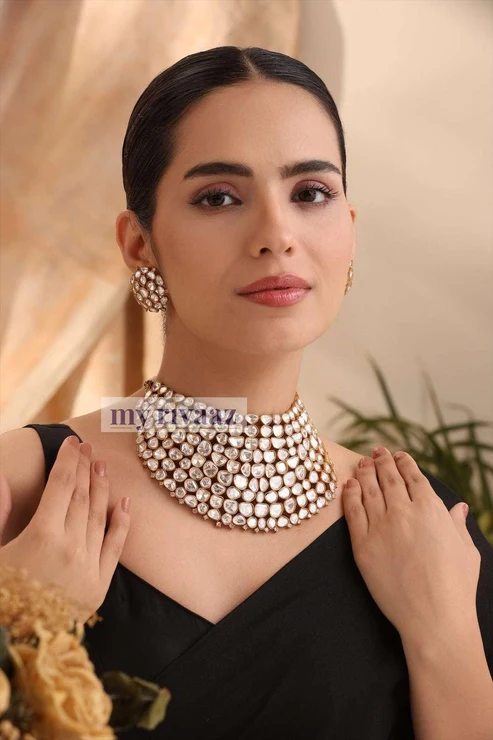
- Choker, a fitted band that sits high on the neck and works well with boat necks and high collars.
- Rani haar, a long layered necklace that falls well below the bust and is usually worn by the bride for the main ceremony.
- Satlada, which means seven strands, usually beads or pearls joined at the sides by Kundan panels.
- Hasli, a stiff curved collar that rests flat on the collarbone and suits deep, wide necklines.
Layering Two Necklaces Together
The classic bridal pairing is a choker worn with a rani haar, so the neck and the chest both carry some sparkle. The pastel wedding trend has shifted how this pairing looks in recent seasons. Brides in mint, powder pink or ivory lehengas often pick white or pale green Kundan with pearl drops, and the all-red set appears less often at day ceremonies. The two necklaces should still share one gold tone so they read as a single set.
Earring Shapes and Where They Sit
Chandbali and Jhumka Explained
A chandbali is shaped like a crescent moon, with the open curve facing up and small drops hanging from the lower edge. A jhumka is a bell or dome shape that swings when the wearer moves. Chandbalis suit oval and long faces since they add width at the jaw. Small jhumkas are easy to wear for a full day at a mehndi.
Ear Chains and Small Studs
Heavy Kundan earrings often come with a sahara, a thin chain that clips from the earring to the hair and takes some weight off the lobe. Brides wearing large chandbalis for eight or ten hours tend to be grateful for it by the reception. Smaller Kundan studs and tiny drops work well for ear stacking, where two or more pieces line up along the ear. This look fits sangeet nights where a full bridal earring would feel heavy.
Head and Hand Pieces at a Glance
Maang Tikka and Matha Patti
A maang tikka is a single pendant on a chain that runs along the hair parting and rests on the forehead. A matha patti adds side chains that frame the hairline and can stretch close to the ears. Pakistani brides often add a passa, a fan-shaped piece pinned to one side of the head. The hairstyle should be planned around whichever piece is chosen.
Haath Phool and Bangles
Haath phool means hand flower. It is a ring joined by chains to a bracelet, with a decorated panel lying across the back of the hand. Kundan bangles in the same stone color usually sit right beside it in mehndi photos.
Putting the Vocabulary to Use
Most mismatched jewelry looks come from buying by photo instead of by name. A satlada and a rani haar look similar on a small screen, yet one stops at the chest and the other reaches toward the waist.
Once the terms are clear, the outfit can guide every choice. Start with the neckline, pick the necklace style that fits it, and then choose earrings and a head piece that do not compete with it. Learn the names, check each piece against the outfit, and shortlist only the designs that suit both the neckline and the occasion.